

Founded 1980
Chair:
Secretary:
Treasurer:
Graham Smith
Jan Thompson
Graham Mumby-Croft
 Home
Home
My Obsession with Adjudications within the Prison Service
With a service period of over 30 years with a direction of travel from Prison Officer to Governor III. I have had an extensive relationship with the disciplinary and adjudication processes during my service.
An Overview of Procedures and Practices (Rule 47/51)
Introduction
Adjudications within Her Majesty's Prison (HMP) service refer to the formal processes by which alleged breaches of prison discipline are investigated and resolved. These procedures play a vital role in maintaining order, fairness, and accountability within the prison system. The adjudication process ensures that both staff and inmates understand the consequences of misconduct and the standards expected in our prison system.
Purpose of Adjudications
The primary purpose of adjudications is to address alleged violations of prison rules and regulations. This process helps to deter future misconduct, uphold institutional security, and protect the rights of all individuals within the prison environment. Adjudications are designed to be impartial, transparent, and consistent with legal and ethical standards.
Types of Adjudications
Minor Offenses: These are typically dealt with by prison staff through internal disciplinary procedures. Sanctions may include warnings, loss of privileges, or temporary confinement.
Serious Offenses: More significant breaches, such as violence or possession of contraband, require formal adjudication hearings. These may involve a governor or an independent adjudicator and can result in more severe consequences, including extended loss of privileges or referral to external authorities.
The Adjudication Process
- Reporting an Incident: When a staff member or another inmate observes a breach of rules, the incident is documented and reported according to established protocols.
- Investigation: The incident is investigated to determine the facts. Witness statements and evidence are collected to support a fair hearing.
- Notification: The accused inmate is informed of the charges and provided with details of the alleged misconduct.
- Hearing: An adjudication hearing is held, during which the inmate can present their case, call witnesses, and challenge evidence.
- Decision: The adjudicator reviews the evidence and issues a decision. If found guilty, the inmate receives an appropriate sanction.
- Appeal: Inmates have the right to appeal the decision if they believe there has been an error in the process or outcome.
Rights and Safeguards
- The HMP service is committed to upholding the rights of inmates during adjudications. These include:
- The right to be informed of charges in a timely manner.
- The right to a fair and impartial hearing.
- The right to access legal representation or advice.
- The right to appeal decisions.
Outcomes and Consequences
Sanctions following adjudications may vary depending on the severity of the offence. Typical outcomes include loss of privileges (such as visits or recreation), confinement, or referral to outside authorities for criminal prosecution. The aim is not only to punish misconduct but also to encourage rehabilitation and positive behaviour within the prison community.
Conclusion
Adjudications within the HMP service are a cornerstone of prison discipline and accountability. By adhering to fair procedures and respecting the rights of all parties, the adjudication process helps to maintain order, safety, and justice within correctional facilities.
The above is what I learnt at Aberford Road Officer Training College in 1974 and being “so well” informed I arrived at HMP Leeds confident that I was equipped to manage any disciplinary issue that I might encounter! To my surprise, I discovered on my arrival that Leeds prison had been operating quite successfully since 1847 without my up to date and freshly acquired knowledge. The resident staff, as early as my first day, were keen to advise me that “this is Leeds” so I should forget all the previous training information and concentrate on absorbing and applying “the Leeds way” of operating.
Nevertheless, taking heed of the local advice, I still found the adjudication process to be an adequate way of managing infringements of the prison rules. Being of a sturdy and generally athletic build I found my own satisfactory way of dealing with verbal abuse and resolved never to use the Adjudication process for this level of indiscipline, but I did use it quite robustly for offences that could not successfully be managed at a personal level including fighting/violence, property violations, disobedience and failing to comply with prison rules etc.
My early years were undertaken under the watchful eye of Chief Officer 1 George Williamson, and I soon became a prolific user of the Rule 47 mostly because I was unwilling to let things go just because it was inconvenient. One rule at Leeds was if you had a report before the Governor and was detailed to a Main Shift - which normally meant doing a Crown Court duty - then you were kept in to deal with the report. This deterred many officers from dealing with issues properly because it meant losing a day out and subs. I was not one of those officers. I was zealous when it came to maintaining discipline among the population.
The outcome of my enthusiastic reporting caused George Williamson concern because his Clerk, who prepared the paperwork for reports, complained to him about the extra work I was causing him. George, bless him, chose to deal with his clerks complaining by making me his clerk when the time for redeployment to fixed posts came about. This was a major turning point in my career; I was now in the center of power. I did have a great deal of administration to undergo, typing to do preparing on average seven adjudications every day for the Governor. I did keep me busy along with all the other administerial duties.
It took four years to complete my tour of duty in the Chiefs office and soon after I was promoted to Senior Officer and unusually posted in-situ. I was straight away put as in-charge of the punishment landing (“The block” by 1970 speak and by 2000’s known as “Care and Separation”). My duties involved the day to day running of the unit and administering the adjudication processes. This was a wonderful opportunity to see the adjudication process working in reality. I supported several different adjudicators in the 4 years I managed the segregation unit and observed a few different approaches to the process, all effective but different. There was one who painstakingly wrote down every word spoken in the room and another who paraphrased events. I will make mention of one memorable moment, for me. The very first adjudication I supervised as Unit SO I stood to attention at the right of Governor Bill Martin in what would have been the position of the Chief Officer, who was absent attending to some other event. I observed that the Governor was running out of paper on the adjudication “White Sheet”, so I quietly opened the desk drawer and took out a sheet of foolscap and placed it to the side of the Governors paperwork. Mr Martin steadfastly ignored my offer of paper and continued writing in the margins on the form completing the adjudication. When the prisoner had left the room Mr Martin thanked me for the foolscap but explained that he would never need extra paper because when he had filled the form the adjudication would always be over. It’s also fair to say, now he is no longer with us to argue, that his script was completely unintelligible.
My next connection with the adjudication process was when in 1995 I was promoted to GV at HMP Belmarsh and sent to Newbould Revel on an Adjudicators course tutored by the indomitable Lynn Bowles. This was my first encounter with Lynn, and it is fair to say that my education was advanced significantly.
I arrived back refreshed at Belmarsh and was placed on the adjudication panel but was rarely called upon only when more senior Governors were not available. We did have one litigious prisoner (Whose name conveniently eludes me) who I regularly seemed to be the only available Governor when he had bumped into rule 47. He always appeared on adjudication armed with a copy of prison rules, a copy of the discipline manual and a McKenzie Friend; it was a welcome distraction and good fun.
Belmarsh was where I developed what I can only describe as an obsession with the adjudication process.
My domestic circumstances changed with a family bereavement which created a need to return to Yorkshire. This need was satisfied with a posting to HMP The Wolds as Deputy Controller in the new rank of GIV and working for the incumbent Controller Gordon Morrison. Gordon, it transpired was an expert, and the departments go-to when someone was needed to conduct investigations and write reports on deaths in custody. Happily, for me this kept Gordon very busy and I found myself conducting a greater number of adjudications and enjoying long periods of substitution in the controller’s enforced absences.
This welcome break from my previous 24 years “sharp end” service lasted about 12 months and then I was posted (willingly, at the request of the area manager) to HMP Doncaster. Doncaster was unusual in several different ways, it was a big local jail, managed by the private sector and it housed category “A” prisoners. Unlike HMP The Wolds which was a Cat C Group 4 operation with just the 2 Governor grades and a single PA support. Doncaster had a G3 Controller, a G4 Deputy and a G5 Support complete with a PA and 2 other treasury Grades making up our complete fiefdom.
It transpired – intended or not - that the position of Controller was little more than somewhere to locate G3s with aspirations for Governing Governor Posts. During my 4 years tenure I had worked for three controllers three of whom were promoted to Governing Governor posts and the last one became a Super Controller with I think responsibility for 4 Privately managed prisons. Consequently, I managed to operate as a temporarily promoted Gov4 to 3 for about half of my time at Doncaster and at the end, up to retiring, I was adjudicating at Doncaster and The Wolds.
The new role fitted my interest in the application of Prison discipline perfectly. Adjudications at Doncaster were essentially my job and 20 to 30 a day were the norm. Simply put, The Controller dealt with the politics, I did the Discipline and the G5 managed the contract. I was in my element the whole discipline issue was a disgrace it was clear that the officers had received only the basic training for adjudications and were operating on the basis that whatever you offered in evidence the adjudicator would simply accept it, find guilt and punish. They had no useful knowledge of gathering, compiling and presenting evidence at the hearing. There was also a lack of understanding on how punishments should be applied in the day-to-day activities of the prison. Doncaster being privately run my loyalty was essentially to the Prison Service. My background provided a balance of loyalty to the service and the desire to see these young officers do well. It was clear from the number of adjudications that I was dismissing there was a training need, but I had no training function within the prison.
Each time that I dismissed a charge I would keep the officer back for advice but with the number of staff I was not getting the information through to the majority. I concluded that the way forward was to create a monthly bulletin detailing the dismissals and explaining the reasons and so the Newsletter was launched in March of 2002 and continued until my retirement in May of 2004 when I wrote my last epistle. This last Newsletter continued evidence of the great improvement in the outcomes of adjudication. Improvements not only in results but in the reduction of numbers of charges brought.
It was most gratifying that throughout my adjudicating career I was never overturned in any appeal. It was also very pleasing to me that the existence of the Newsletter became known, and many Governors asked if I would forward copies to them as they became available.
Should you be interested in looking at an example of a newsletter I will be happy to forward a sample for you, simply email me at roger@rsoutram.co.uk.
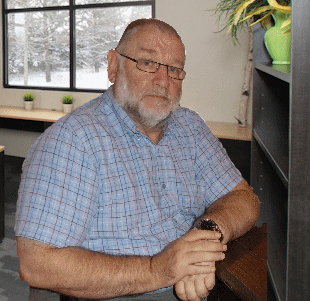
Roger Outram
