

Founded 1980
Chair:
Secretary:
Treasurer:
Graham Smith
Jan Thompson
Graham Mumby-Croft
 Home
Home
PRIVATE PRISONS OF YORE
By: Peter Atkinson.
Retired 2004 from Northumberland Prison (formerly HMP Acklington)

Peter Atkinson
“Overcrowding and inhumane conditions… gaoler corruption…disease and malnutrition…” Perhaps reference to overcrowding might have a familiar ring, but the rest of the quotation is not any kind of contemporaneous comment on prison conditions. Rather, they are John Howard’s conclusions in his 1777 report on the state of English and Welsh private gaols. He visited literally hundreds of them and to say he was shocked by what he found would be an understatement.
In 1991, the Criminal Justice Act introduced the principle of private prisons in England, and a year later in May 1992, the Wolds in East Yorkshire opened as the first private prison in Europe. Since then, the private portfolio has expanded to 14 prisons run by G4S, Sodexo and Serco from Northumberland to Ashford in Kent. The arguments on both sides of the debate surrounding the issue of whether private companies should run parts of our criminal justice system are legion. But, put that discussion on one side because there was a time when private prisons were the only form of confinement across the whole country. Never mind Sodexo and the rest, Bishops, the aristocracy and the Crown all oversaw local gaols throughout the length of the land. By any standards, the conditions in those private gaols in the 18th century until the early 19th century, were mostly vile. They were run for profit where those who could summon up funds to pay the gaolers could ease their misery, whilst those with no financial help had to endure the most repressive and barbaric conditions. It took John Howard (1726 – 1790) and latterly Elizabeth Fry (1780 – 1845), among others to front the movement away from the foul, noxious, desperate prison conditions towards something more humane.
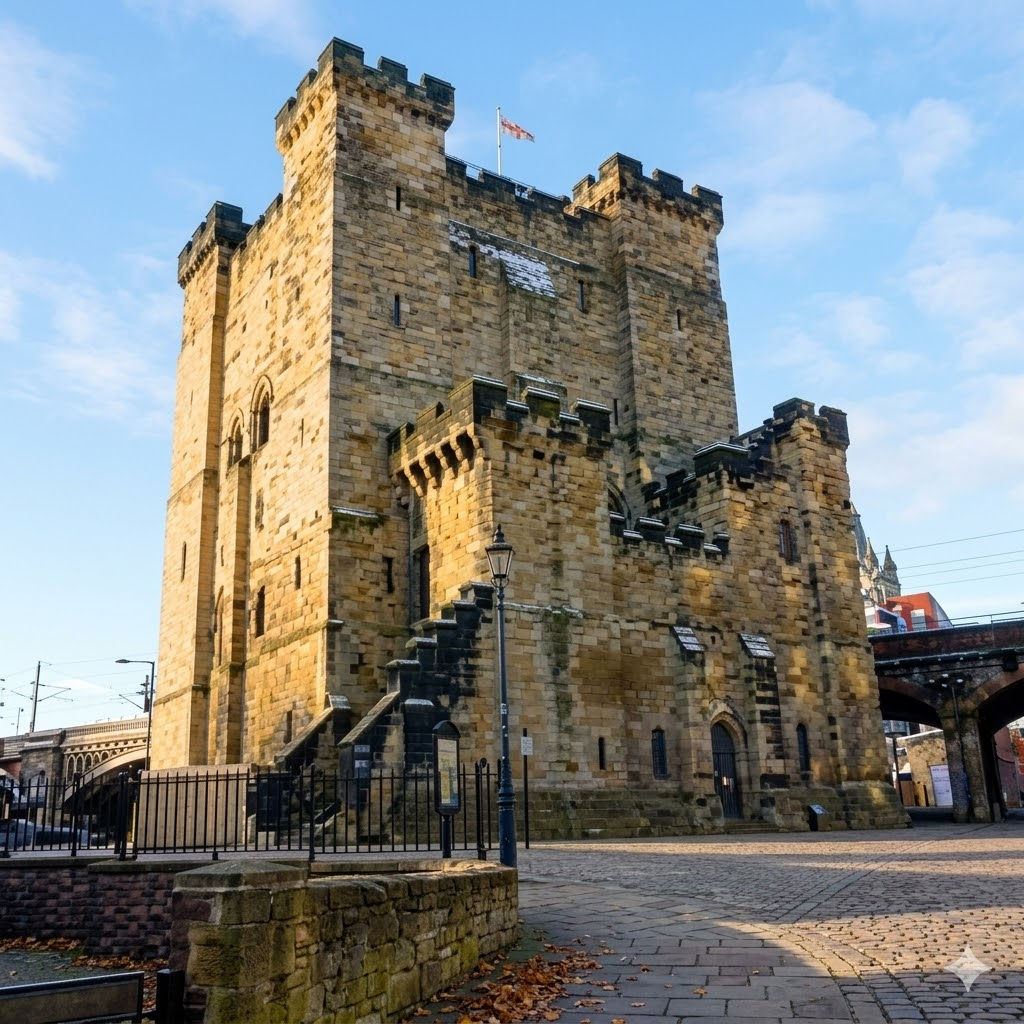
The old Castle Garth dungeon prison
Newcastle castle keep
Coming to the rescue was the 1823 Gaols Act, that formed the basis of the state-run system that developed into what we are familiar with today. A more humane regard for offenders saw an end to the appalling conditions in the country's gaols, although hangings (permanently abolished in 1969) and birchings (ended in 1962) continued well into the 20th century. Just as an aside, I was a newish Assistant Governor at Stafford in 1980 where I served alongside Larry Walsh, then Chief Officer 1, who told me that he carried out an authorised birching at Armley prison in Leeds when he was a young officer.
Letters from those awaiting transportation to Australia, as well as contemporary newspaper articles, reports to Parliament and John Howard’s reports on prison conditions, all provided a keen
insight into the horrors that were manifest for those felons and debtors who transgressed the law throughout the 18th and into the 19th century. Debt was seen as a crime and offences against property could often be treated more harshly than murder.
Just as a sample of aristocratic gaol ownership we start with the notable Duke of Portland from Bolsover Castle who owned the notorious Chesterfield Gaol. It was situated in South Place, near the river Hipper in the centre of the town. In 1770, following a visit by John Howard, the Town Gaol as it was known experienced inmate conditions that were described as, “…truly horrific”. The gaoler paid an annual rate to the Duke of £18 12s but exacted a whole lot more than that from the inmates he was looking after.
Howard described a tiny hatch to the cellar below, reporting that the door had not been opened for weeks. The one room cell accommodating four prisoners at the time of Howard’s visit, had no water, no heating and no bedding. Another aristocrat, the Duke of Leeds, had a debtors gaol in Gaol Lane at the top of Northgate in Halifax. To buy food, the inmates had to pay 3/6 a week. In the Duke of Leeds gaol, felons did not spend long in their awful prison before being taken to the gibbet on Gibbet Hill where their heads were cut off. One story recounts a country lady riding by at the moment of an execution. The executioner's axe was said to have come down with such force that the head jumped into one of the country lady’s hampers- mm, I’m not sure about that story. Another aristocrat, the Earl of Arundel, owned Penzance Town Gaol in a stable yard off the Corn Market. A soil floor with a pittance of straw and one small high window, confined about 12 prisoners a year.
Turning to those prisons owned by the Crown, we can start with the most notorious of all in Marshalsea prison in Southwark run by the Knight Marshal of the royal household. This had a special notoriety because it was so large. It held many hundreds of prisoners in a range of buildings. Reports in the early 18th century refer to it being an “earthly hell” with torture, thumb screws, iron hoods, beatings, and confinement next to rotting carcases. Those who survived such ill treatment, often died of starvation. It was reported that in warmer weather, there was such overcrowding that 8 or 10 prisoners died every 24 hours.
The three other Southwark royal household run prisons were The King’s Bench in St George’s Fields, the Southwark Compter in Tooley Street and the White Lion prison on Angel Alley off Borough High Street. If torture and physical abuse were not bad enough, the situation was made worse by the prevalence of typhus or “gaol fever” as it was known. It’s somewhat ironic that on a European inspection of gaols John Howard died of “gaol fever” typhus in Kherson, Ukraine, after tending to a sick woman in a military hospital. There’s a bust of John Howard over the gate of the old Shrewsbury prison on Howard Street.
The picture of Castle Garth on page 16 which was the old Newcastle castle keep, served as a prison in the 18th century right up to 1820. This underground prison was inspected by a prison reformer called James Neild in1802. To gain entrance through a trap door he had to get a man with a shovel to clear away the “dirt and filthy rubbish” before he could get in. Neild described it as,” … the worst of prisons…”, with a damp and dirty set of dungeons, where prisoners were chained to the walls. The small part of the dungeon in complete darkness that was sectioned off for the seven women, had a soil floor that was permanently wet. When it rained the water poured down the walls to cover several inches of the floor. The only place of refuge for the inmates was to sit on the top of six stone steps that led into the room. In the second half of the 18th century Lord Ravensworth leased the whole castle from the Crown, taking on the gaol as well.
The church was deeply involved with gaols during the 18th century where for example, the Bishop of Ely’s palace accommodated a prison for recalcitrant Catholics in the early part of the century. From some of the inmates' subsequent documents, it was recorded that prisoners were chained to the floor with spiked collars around their necks and iron bars over their legs. Lying in their own filth for weeks, inmates were practically starved, with no access to fresh air. The Bishop of Durham was an active owner of his town gaol at the Great North gate in Saddler Street; the Bishop of Winchester owned The Clink in Southwark; the Archbishop of York managed his own gaol in the crypt below his Sepulchre chapel and the Bishop of Sodor and Man controlled Rushen Castle prison on the Isle of Man. These are just a sample of religious leaders running their own prisons.
What’s my point with all this talk of 18th century private prisons? Well, first off, the prompt for writing this article was a book by Robert Hughes called The Fatal Shore. In great detail Hughes documents the horrific and appalling life for felons and debtors in county gaols in 18th century England. He describes the misery on the Hulks and the subsequent horror of transportation to Australia. I was struck by the savage cruelty that Hughes referenced when describing the inhuman conditions experienced by English criminals, as well as in the early Australian prison settlements, especially Norfolk Island. It was not simply the appalling conditions of the gaol buildings in which prisoners at that time were confined, but the abject and wanton cruelty often inflicted on them by their gaolers.
Perhaps not particularly profound, but the simple point for me in this article is that no matter how much we might moan about certain aspects of our current private or even state-run prison system, we can perhaps all agree that things are clearly a million times better than they once were.
